

Why Iran’s fall would be a strategic nightmare for Pakistan, not a windfall
Pak’s military establishment appears encouraged by expectations of more transactional US approach under possible Trump administration
Why Iran’s fall would be a strategic nightmare for Pakistan, not a windfall
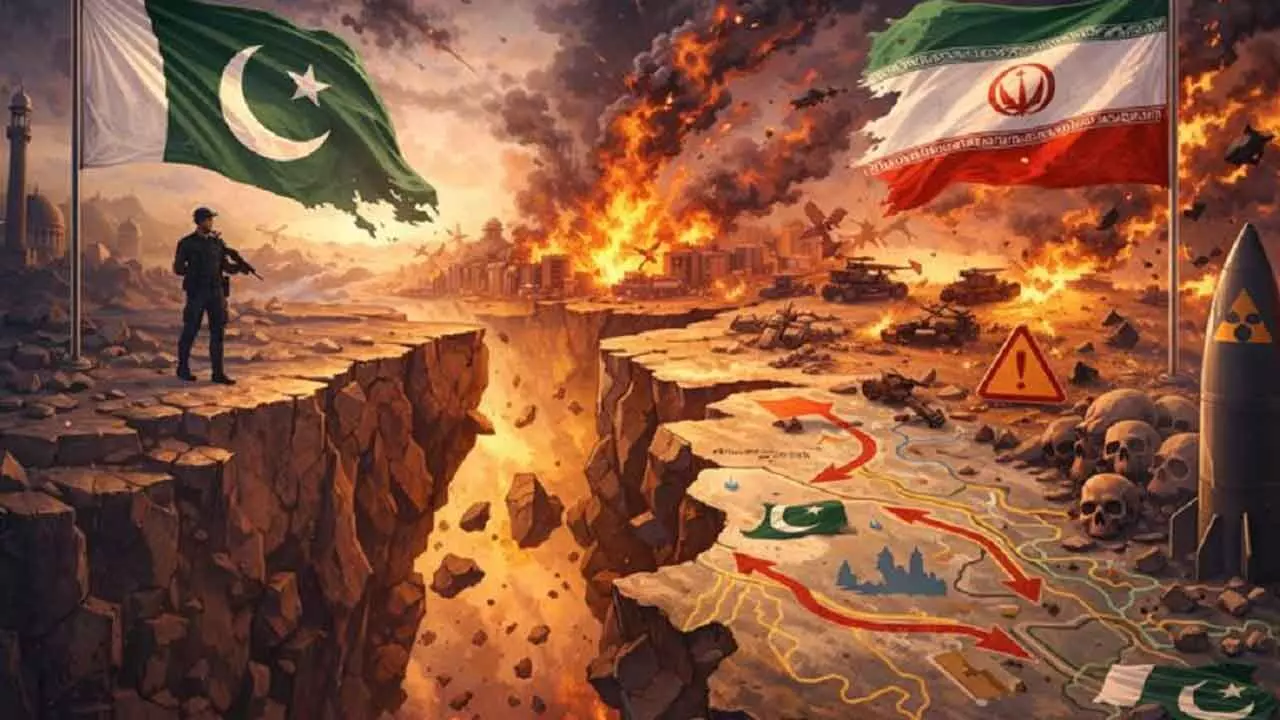
The possible collapse of Iran’s clerical regime would have far-reaching consequences for Pakistan, which might alter its four decades of relations with the US. Contrary to the belief in Rawalpindi that a US move against Iran could restore Pakistan’s geopolitical relevance, such a shift could, in fact, accelerate Pakistan’s strategic decline.
Pakistan’s military establishment appears encouraged by expectations of a more transactional US approach under a possible Trump administration, especially after Operational Sindoor. Open-source reports suggest Islamabad has offered access to rare-earth minerals in Balochistan and logistical cooperation in the event of a US confrontation with Iran. The assumption is simple: help Washington regain importance. That assumption is deeply flawed.
A post-clerical Iran would not strengthen Pakistan’s position. It would weaken it, perhaps more than any event since 1971. In fact, Iran’s opening would strip Pakistan of its most valuable strategic asset: its monopoly over access routes, mediation, and leverage in the region. It would expose Pakistan’s internal vulnerabilities and permanently alter the balance of power in South and West Asia.
This outcome rests on four realities: the loss of Pakistan’s logistical leverage, changes in Afghanistan, growing pressure in Balochistan, and Washington’s deep trust deficit with Islamabad.
Pakistan’s relevance was built on geography, not trust
For two decades, Pakistan mattered to the United States largely because of geography. During the Afghanistan war, NATO supply lines ran through Karachi and Pakistan’s road network. This gave Rawalpindi influence far beyond its economic or diplomatic weight.
That leverage was used repeatedly. After the 2011 Salala incident, when NATO airstrikes killed Pakistani soldiers, Islamabad shut down supply routes for months. The US had no choice but to depend on costly airlifts and Central Asian routes.
But this leverage existed only because alternatives were unavailable. Iran, a geographically better-positioned country, was cut off due to decades of hostility toward Washington after the 1979 revolution. Once that barrier disappears, Pakistan’s advantage disappears with it.
Iran’s opening would end Pakistan’s leverage
A post-clerical Iran would offer the US direct access to the Arabian Sea, overland routes to Afghanistan, and strategic depth Pakistan can no longer monopolise. For Islamabad, this would be a serious blow. Its ability to pressure Washington through transit rights, intelligence cooperation, or airspace access would lose value. Pakistan would move from being “necessary” to merely “optional”.
So would the benefits it long extracted: military aid, diplomatic indulgence, and tolerance of internal contradictions. Once Iran becomes a viable alternative, Washington has little reason to continue paying these costs.
Afghanistan without Pakistan at the centre
The US is unlikely to return militarily to Afghanistan. But it may recalibrate its approach using intelligence, diplomacy, and regional partnerships. The Taliban face economic collapse, sanctions, and international isolation. Russia and China have already begun pragmatic engagement.
In such a setting, indirect US engagement is possible, especially if Iran becomes accessible. Pakistan’s long-held role as the Taliban’s gatekeeper is already fading. New Delhi has rebuilt humanitarian links. Central Asian states, Russia, and Iran maintain their own channels. If Washington gains access through Iran, Pakistan’s influence over Afghanistan will shrink further.
The Taliban, once Pakistan’s most valuable proxy, could become independent actors seeking legitimacy from multiple powers. The long-standing “strategic depth” doctrine would finally unravel.
Balochistan: Pakistan’s weakest link
Balochistan remains Pakistan’s most fragile internal fault line. Rich in resources and strategically located, it has a long history of alienation and insurgency. Its importance has grown with China’s investments under CPEC, especially at Gwadar port.
A weakened Pakistan, no longer a strategic asset, would find it harder to manage separatist pressures. While there is no declared US policy to fragment Pakistan, American strategic thinking has long acknowledged Pakistan’s internal instability as a risk. If Pakistan loses external backing and leverage, internal cohesion becomes its biggest challenge. Balochistan would no longer be a peripheral issue—it would be central.
The trust deficit washington will not forget
Strategic relationships depend on one basic principle: trust.
The popular political thriller novel of the 90s, Honour Among Thieves by Jeffrey Archer, suggests that the basic idea of keeping your word, even in shady circles, is the root of any kind of honour in society, because without trust, even criminals can't function. Pakistan broke those rules repeatedly.
Over two decades in Afghanistan, the US concluded that Pakistan was not just unreliable, but often duplicitous. The discovery of Osama bin Laden in Abbottabad confirmed long-held suspicions. Congressional hearings and official testimonies accused elements within Pakistan’s security establishment of supporting groups that attacked US forces.
Nearly 2,400 American soldiers died in Afghanistan. In Washington, such losses are not forgotten. Pakistan is now seen as useful when needed—but never reliable.
Pakistan’s deepening embrace of China has only reinforced this view. Handing strategic infrastructure like Gwadar to Beijing convinced Washington that Islamabad prioritises short-term gain over long-term alignment. That perception carries lasting consequences.
What this means for India
For Bharat, these changes are complex but manageable. Greater US influence through Iran would reshape the Arabian Sea and intensify great-power competition. But it would also reduce Pakistan’s ability to use geography as a weapon.
New Delhi’s long-standing commitment to strategic autonomy stands vindicated. Unlike Pakistan, Bharat has not leased its geography or outsourced its security decisions. As the region reshapes itself, Bharat enters this phase as a balancing power, not a client state.
The fall or transformation of Iran’s clerical regime would not revive Pakistan’s fortunes. It would expose the weakness of a strategy built on leverage without trust. With new routes, alternative partners, and little tolerance for duplicity, the United States no longer needs Pakistan the way it once did. For Pakistan, the real danger is not encirclement—but irrelevance.
(The author is Founder of My Startup TV)





